Monday, June 2, 2014

The Rainforest: a place full of amazing.

Why is rainforest biodiversity so special, and why do so many plants and animals call it their home?
In the last two years, I’ve had the privilege of visiting two of the great tropical rainforests of the world: the Ecuadorian Amazon, and the Bornean rainforest. I consider it a privilege, because the majority of people in the world never set foot inside of a rainforest. 50% of the world population live in cities, and that number is projected to jump to 70% during the next 35 years. The tropical rainforest is just about the last place the average human would want to venture into, and it’s not that hard to see why. It’s almost impossible to live in it.

Somewhere hidden between all those leaves and branches are countless species of insects, and other animals, invisible to our eyes. 

When western explorers first ran into the rainforests of the Amazon, Africa, and Southeast Asia, and saw the immensely dense growth and all of the gigantic trees, they concluded that the soils there must be the most fertile on earth. Counter to intuition however, the soils there are some of the most nutrient poor on earth. This is because nutrient cycling is incredibly fast in the rainforest, and any nutrients that make it into the soil are immediately absorbed by the roots of all the plants and taken up into the canopy. In fact, 99% of the nutrients of the rainforest is found in the vegetation itself, and not the soils. So any crops one tries to plant in the rainforest will surely fail.

Other than the puny human (try to spot the climber up there!), within those trees are a whole lot of nutrients. 


If that wasn't enough of a deterrent to any would-be residents of the rainforest, the rainforest is also an incredibly dense and arguably one of the most difficult to navigate environments in the world. There are few landmarks, and the trees are so high and the vegetation so dense that one can’t see more than 50m into the distance. It’s no coincidence that the word “jungle,” which is of sanskrit origin, means wasteland.  Without sufficient training, equipment, and supplies, a trip alone into the rainforest would end in disaster for the average person. Our primate ancestors called the rainforest their home, but ever since humans evolved their way into the savannas of Africa, few have ventured back into their ancestral home. We just can’t live in it.

Funnily enough though, in the grand scheme of things, humans seem to be the great outlier in terms of where we live. Covering less than 2% of the earth’s surface, the rainforest nevertheless contains more than 50% of the world’s species of plants and animals. More and more are discovered every day. And not just small things like insects (like the plant hopper!) or plants (like this crazy Chilean chameleon vine – technically not in the rainforest but too cool to not share). Mammals have been discovered as well, as shown by the recent discoveries of the Olinguito in the Amazon, and the venomous Slow Loris in Borneo (the only known venomous primate in the world!). Considering all of the life that’s out there, it’s crazy to think that many scientists estimate that only one fifth of the world’s species have been described. Even how the rainforest became so biodiverse is kind of a mystery, and there’s a multitude of theories proposed to explain it. One of the reasons given is that the environment is so heterogeneous and complex (to begin with, there is a vertical element not seen in other environments to the extent as it’s seen in the rainforest, which has trees 200+ft) that there are thousands of potential niches for different animals to occupy, and speciate.

The golden-mantled tree kangaroo, recently discovered in the Foja mountains of Indonesia. I didn't even know there were kangaroos on this side of Wallace's line!


So with all of this biodiversity in the rainforest, you might think that if you walk into the rainforest, you’ll be running into all sorts of animals left and right. The truth is not quite that however. With all those impressive biodiversity facts and species numbers I always heard about, the first time I visited the Amazon rainforest in the fall of 2012, I was expecting to run into all sorts of crazy animals the minute I walked out. So you can imagine my surprise when I found the rainforest to appear overwhelmingly uniform. And to the untrained eye, that’s exactly what it looks like: one big pile of green. Broccoli broccoli broccoli, everywhere. Out in the open, there are no animals in sight or anything besides bunches of of branches, vines, and leaves. You might spend a few days in the rainforest, and then leave thinking “alright, I think I saw all there is to see.” But in actuality, that couldn't be farther from the truth.

To get the most out of the rainforest, and experience the biodiversity that it has to offer, it takes a lot of patience, and a very observant eye. You know for a fact that everything is out there because your ears don’t lie. You can hear the call of the wild every morning and every night, when multitudes of species in the rainforest – cicadas, gibbons, birds, etc. – call out and resonate throughout the rainforest. But everything, absolutely everything is hiding. Under leaves, blending into the cracks of tree trunks, high up in the canopy, almost every form of life out there blends into its surroundings, and appears invisible to those who don’t know where to look. But it The longer you spend in the rainforest, the better you’ll be at spotting everything. It’s not ‘til then that you realize you could spend every hour of every day walking around in the rainforest, and not see everything. Even the big things! I have spent almost a year now living at Gunung Palung National Park in Borneo, and I’ve yet to see any sun bears, leopards, pythons, or lemurs. But they are out there, and I’m still holding out hope that I’ll at least get to see a bear before I leave!

If I act like a sun-bear, maybe all the sun-bears will come out too.


It takes a bit of luck to see cool things out here, some of which I’ve had during my time at Gunung Palung. I’ve definitely seen over 15 orangutan matings now (so many that I’ve lost count!), which tend to be pretty rare events to see, much less capture on film (which I also have!). I’ve also seen two male orangutans go at it head to head on the ground, extremely rare events to witness. My most notable sighting, and the source of a bit of jealousy at camp, was when a Binturong (AKA, a bearcat!) ran up to me as I was sitting somewhere up in the mountain; I heard a noise coming down hill, and prepped my camera, unknowing of what exactly was coming down but ready to get it on film. I got really excited when I saw what it was, but it passed by me so quickly that I could only capture a moving blur on the camera. But the ‘cat’ in the bearcat was a curious creature indeed, and when it spotted me it turned around for a closer look. As it stared at me from a few meters away, I managed to snap this photo, proof of my sighting to everyone at camp!

A Binturong, AKA a Bearcat. I bet there are only a handful of non-camera trap photos in the world taken of these guys in the wild. 

Every time you step into the rainforest, what you see is luck of the draw, a spin of the wheel. But with some patience and a good eye, you can double the odds. The rainforest can definitely be a bit overwhelming, but it is without a doubt an awesome place to explore. 

Monday, March 24, 2014

Pongo, the weird cousin in the great ape family

Last post I talked about the differences between Bornean and Sumatran orangutans. But what makes orangutans different from all the other great apes? There are 4 extant great ape genuses: humans (Homo), chimps (Pan), Gorillas (Gorilla), and Orangutans (Pongo). Out of all these, the orangutans split off from the rest the earliest, and are genetically the least related to humans. In many ways, they are the weirdest of the great apes!

To start, they are the only remaining ape species native to Asia. All the other great apes are found only in Africa (except for humans, which today are a global species – but we originally evolved in Africa). Note that I say ‘remaining’ ape species. Millions of years ago, apes were rampant across the old world, including many species in Asia. At some point, most of these species went extinct, and only the orangutan and gibbon line survived the present day.  Were any of these species ancestral to orangutans, and if so which ones? No one really knows for sure, but some of the skeletal remains we have found in Asia show some morphological similarities to Orangutans. Search Sivapithecus if you want to find out more. Interestingly, there was a gigantic species of ape called Gigantopithecus living in Asia until fairly recently (and by fairly recently, I mean thousands of years ago). Humans were already around, and may have run into this other ape creature – in fact, some people think this may be the origin of the ‘Yeti’ or ‘Sasquatch’. Maybe when humans and Gigantopithecus coexisted long ago, humans lived in fear of this creature and shared stories to each other about it; through the retelling of these stories from generation to generation, the creature survived in our memories and into legend, even after it became extinct. Of course, there are always those who insist bigfoot/yeti/sasquatch hasn’t gone extinct, but let’s not get into that. 

Orangutans are the most arboreal of the great apes. Chimpanzees, Bonobos and Gorillas spend a lot of their time in trees, but they also spend an extensive amount of time on the ground, where they move around by knucklewalking. This is probably a big reason why orangutans have been the least studied great ape; it’s a lot harder to find them, follow them, and take date on them, if they’re constantly up high in the branches, out of view. Humans are obviously the least arboreal of the five species of great ape, given that we’re bipedal and spend virtually all of our time on the ground. Orangutans however, spend almost all of their time up in the trees. They are very well adapted for it, having long arms and long legs for reaching across gaps to grab branches, and they have very long fingers and opposable thumbs on both hands and feet, which allows them to firmly grasp the branches and trunks they use to move around.  It’s almost like the have four hands rather than two hands and two feet, allowing them to have multiple points of contact to the trees that they use to move around, which makes it safe for them to be up so high. 

They are masters at this kind of locomotion, being able to ‘polevault’ from tree to tree by bending the trunks and swinging to an adjacent tree, as well as brachiating their way throughout the canopy. Primatologists who study orangutans have traditionally thought that only the flanged males come to the ground often; however, a recent study which used a collection of camera traps distributed over a study site, found that all age-sex classes of orangutans come to the ground fairly often. Personally, I’ve seen females come down to the ground as well, but only a handful of times (and one of the females was traveling together in consortship with a flanged male, so perhaps she felt safe enough in his presence to come down). We still don’t know if this is a universal thing among all groups of orangutans, or something that varies from site to site…maybe they all do this, but just not often in the presence of people. This just shows that there is still a lot to learn about orangutan behavior.

In contrast to all of the other great apes, which are extremely social creatures with complex social dynamics and networks, orangutans spend the majority of their time alone. They do interact with other individuals from time to time, so they could be described as solitary but social. There is not much long-term social bonding. Usually mothers and their offspring will remains in association for a long time, and will overlap in home range, but eventually their social bonds weaken and they end up living independent lives. The relationship seems to last longer with daughters, as male offspring will usually migrate out of their home range into a new area. The consequence of this is that in a particular area, a lot of the females will be related, but few of the males are. Often times we see that when orangutans form a party (which is the technical term for when two or more orangutans interact and travel with each other during the course of a few hours, a day, or longer), they are all female and related.  Sociality also depends vastly on fruit availability. If fruit availability is low, they will tend towards solitude to avoid competition. If fruit availability is high, they will aggregate in the feeding trees more often and tolerate each other’s presence; there is enough food to go around and the benefits of social interaction outweigh the costs of sharing the food supply. Of course, all of these facts is what we has been traditionally written about in the orangutan literature. 
More recently, researchers are starting to find that perhaps orangutans are more social than we think. Definitely not as social as other apes, but sociality is still a very important part of orangutan dynamics. 

Flanged males (If you’re wondering what flanged males are, I’ll explain it in the next post!) prefer traveling alone, unless they are in consortship with a female; they do not under any circumstances associate with any other males, and will get aggressive upon encountering others. Unflanged males tend to avoid other males, but sometimes they will form bachelor squads with other unflanged males. 

This is just the tip of the iceberg when it comes to orangutans. What I mentioned before about flanged/unflanged males is a very interesting dynamic among orangutans, and I’ll be diving down into that on the next post. 

Wednesday, March 19, 2014

What is an orangutang? I don't know, because this post is about orangutans.

Before I begin:  I’ve been away from working on this blog for a while. I started writing this next series of posts a couple months ago, but I just never posted them. I’ve been busy up at camp and 
have had to shift my efforts elsewhere. My time here for the last year has been great . I’m not going to be here forever though, and I don’t want to leave without sharing my experiences with all of you. So I’m going to work extra hard to get at least one post out a week. But moving on…

If you’re reading this, you’re probably well aware that we’re all about orangutans here. So here’s a question…what is an orangutan? A simple question perhaps, but when it comes to simple questions, the answers are rarely as simple or as obvious as we think. As an example, ‘why is the sky blue?’ is a simple question, but to answer it you have to go neck deep into the physics of light and refraction…which means that for most of human history, a simple fact that every 
person who ever lived has been well aware of (that the sky is blue) could not be truly explained until the last 100 years.  

‘What is an orangutan?’ is a rather open-ended question, and has answers on a multitude of levels. So let’s start with something basic: what does the word even mean? Well first of all, the spelling. It's not orangutang. That's just a weird word some redneck said one day, and it somehow spread enough that a lot of people think it's how you spell and/or say orangutan. Actually, it might even be because of that fake juice drink that is supposed to taste like oranges, but really just tastes like like sweat, sugar, and food coloring mixed together. I'm talking about you, Tang. You remember the commercials in the 90s right? A bunch of orangutans running around wearing clothes, sunglasses, and  drinking fake orange juice? I think some unclever guy in their advertising department was trying to think of a name for a new orange drink, and thought "Orange? ORANGEutangs? I got i! TANG!" Uh. No, buddy. There's no G in there. Now nobody knows how to say orangutan. Thanks Tang.

Actually word ‘orangutan’ comes from the Indonesian/Malay words “orang” (person) and “hutan” (forest). So 
orangutan means “person of the forest”. Note that this is why we call the orangutans at Cabang Panti OHs.  So even before the theory of evolution was introduced, or before Alfred Russell 
Wallace came to the Malay archipelago and provided the first full description of orangutans to science, the native Indonesian/Malay people recognized the great similarity in appearance between orangutans and people. Today, we know why we’re so similar: Both humans and 
orangutans are apes, and we share a common ancestor and 97% of our DNA with them.  A word on apes: don’t call them monkeys, unless you want every primatologist within a 15-mile radius 
to track you down and give you a rant about the differences between apes and monkeys. Simply put, apes are a group of primates with upright postures, stiff lower backs, and (most importantly) 
big brains for their body size. If you want a quick and dirty way to distinguish apes from monkeys, well monkeys have tails and apes don’t. Other apes include chimpanzees, bonobos, gorillas, gibbons, and (of course) humans (no disrespect to gibbons, which are classified as lesser apes rather than great apes, because they’re smaller and more distantly related). 

There’s two species of Orangutans: The Sumatran Orangutan (Pongo abelii) and the Bornean Orangutan (Pongo pygmaeus). The bornean species is further divided into several subspecies, 
depending on where the population is found on the island. The orangutans at Gunung Palung are classified as Pongo pygmaeus wurmbii, and these are found in most of central Kalimantan as 
well. The Sumatran Orangutan is found only in Sumatra (I know, plot twist!). While both species of orangutans are endangered, the Sumatrans are listed as critically endangered, because they 
have an incredibly small population. 
There’s a few differences between the two species: Sumatran orangutans are a bit larger in body size, and seem to have a slower life history than Bornean orangutans (e.g., they take longer to 
mature and have offspring less frequently, among other differences). This may be part of the reason that Sumatran orangutans are more endangered, since their life history may make their 
populations slightly more vulnerable to hunting and habitat destruction. The Sumatran species almost rarely comes down to the ground, whereas the Bornean ones do so periodically. There is 
little danger in coming down to the ground for Bornean orangutans, but the ones in Sumatra have a big problem to worry about: the fierce Sumatran tiger! It’s a risk coming down to the ground 
for them, because there might just be a hungry beast waiting for his lunch to climb down the tree – this may account for this behavioral difference among the Bornean and Sumatran orangutans. 

Those are just a few of the differences between both species. But what makes orangutans different from all of the other apes? That’s what I’ll be talking about in the next post. 

Wednesday, October 16, 2013

Jungle Problems: Ectoparasites

Let me tell you something about living in the rainforest: You've got to get used to the idea that you are sharing living space with the hundreds of tiny little creatures who live here...They may not charge you rent for letting you live in their home, but there is a price you must pay. The jungle price.

In return for invading their space, all these creatures ask is that you allow them free passage to all the nooks and crannies of your body. Are you in the jungle? Yes? Well congratulations, your body is now a hotel for ectoparasites. There is no avoiding this, and it's just something that you'll accept as a fact of life when you live in the rainforest. 

What are ectoparasites? They're parasites that live on or mooch off the surface of your body. So at least you don't have to worry about parasites being inside you here (on second thought, maybe you do, but at least you won't know you have them.) They parasitize all the local mammals like deer, monkeys, wild pigs, and orangutans. In fact, you can see orangutans scratching themselves all the time because of them, and this is one of the adaptive uses of reciprocal grooming in primates: as in, "you scratch my back, I'll scratch yours, and we'll both be ectoparasite free." Even though these ectoparasites already have plenty of choice in which species of host to invade, that doesn't mean they're going to ignore humans when they arrive. Quite the opposite: you're just like a walking buffet of fresh meat...an entire microenvironment for their parasitizing pleasure.

Let me give you some examples. I sleep in a tent on the ground here. Inside of it, I lie on a tiny little mattress pad made of cotton. It's no tempur-pedic, but it gets the job done and I've slept decently comfortably on it. One day though, I started waking up in the middle of the night with a terrible itch on one side of the body. I usually disregarded it, and just went back to sleep. I'd still feel itchy in the morning, but it would eventually go away, only to come back the next night after going in my tent to sleep. This went on for a while, and I just dismissed it as normal...my thought process was "ah, whatever..it's probably mosquitos or generic rashes from walking around in the jungle. Who cares." The night before I was set to go down to town for the very first time after having been here for two months though, I decided to inspect my mattress after itchniness woke me up again. I turned on my headlamp inside the tent, and got down real low to get a good look at all the little cracks between the seams that cover the whole surface of the mattress. I'm glad that it was my last night, because what I found out was not pretty. There were hundreds of tiny little ticks and fleas living on the mattress...sleeping with me every single night. They were dug in deep, but poke them and they would move around and find another little crack in the mattress to settle in. No wonder I would wake up in the middle of the night constantly...There were hundreds of little pests violating my body every single night. 

Now, a normal person in a normal situation would probably have left the tent right then and there and found somehwhere else to sleep. But I had to wake up at 4:30am to hike out of the rainforest, so I was like "meh, I want to sleep...and they're mostly on THAT side of the mattress, so I'll just squeeze a bit to the other side." When I got back from my break, I beat the crap out of my mattress with a broom, and evicted all those free-loaders.

Similarly, there's also the story of the tick that lived in my bellybutton. I would wake up in the middle of the night feeling something weird in my bellybutton. In a half-awake daze, I would stick my finger in there and feel something inside. I didn't know what it was, but it felt me touching it, because it would  apparently squirm around a bit and make me feel a tiny bit of pain. But I was too tired and dazed to really give a crap and do something about it, so I would just decide to check it in the morning. Except I would always forget. For three nights and three days, the cycle would repeat itself, with me waking up, deciding to check my bellybutton in the morning, and then forgetting to do so. 

Finally, I was eating breakfast one morning and just happened to scratch my belly. The tick squirmed a bit, and I was like "oh yeaaaah, I forgot, I need to check my bellybutton!". Now at this point I didn't know what was in there yet, so when I looked I was very surprised to find a huge tick with a red spot cramped in there, squeezing the folds of my bellybutton real tight. I tried pulling it out with my fingers with no avail, so I got some tweezers and a mirror. I tried playing self-surgeon, but I still couldn't get it out. Then Yadi, one of the indonesian guys here, offered to help. He stuck the tweezers in my bellybutton, grabbed a hold of the tick with the tip, and told me to get ready. Like a little kid that tied his falling milk tooth to a string and attached it to the door so their father could slam it shut and have the tooth come out, I closed my eyes and counted to three. Before I even get to three though, he just yanked it out full force, giving me an split-second 'outie' belly button and a good dose of ouch. 

So yeah...I then threw the half-dead tick into the trees. I hope it still lived so it can tell its friends what happens when they try to mess with me. Ticks and fleas beware.

Monday, September 16, 2013

How I met your OH

For the 15 days after our arrival, Indonesia was on holiday, so we were by ourselves at Cabang Panti. It was really up to us to run everything, including camp logisitics like cooking, cleaning, laundry, turning the generator on, etc. And we would be doing all of the fieldwork as well. Tim and Cheryl, who were here with their kids Russell and Jessica, were both working on their own projects: Cheryl was reviewing research logistics and Tim was doing some photography work for National Geographic. We also needed to collect project data in the absence of the workers. Jenn was doing the data collection, and I would help with the tree tagging and gps tracking. 

We spent a few days following Codet, Bibi, and Barani in the swampy part of the trails. My first couple days following, I realized what long hours we work here: a regular day of following usually lasts from wake-up time at 3:30am, until the OH (short for orang-hutan) makes their nest around 6:00pm. That's almost 15 hours straight, and keep in mind that the workers usually do this five days in a row (and only get one day off in between). After being here for a while, I think regular 9-5 jobs begin might begin to sound like a joke. The bright side of it though? We get to be outside all day, chasing after orangutans. No complaints here. 

The pace of the day can change in an instant: sometimes the orangutans are up in the same tree, feeding on the same fruit, for like three hours...and minutes can feel like hours. Other times, you can be on an intense chase behind a retreating orangutan, bushwacking your way through vines, climbing up rocks, crossing rivers, going down mountainsides, trying to keep up...and here, hours seem like minutes. No days are the same. It always pays to be on the lookout though, becauae you never know whn something interesting is going to happen. Everytime I'm out there, I hope to witness something special, like a mating, a male coming down to the ground, food-sharing, some cultural behavior like leaf-matress building, or agression between male orangutans. There are so many things we don't know about orangutans, but if you follow them long enough, you might see them do something that no one has ever seem them do before. 

That's what makes orangutan following so special to me...it can exciting at times, boring at times...but you get to witness these crazy cool insights into the life of an orangutan, and see things rarely seen by other people. You begin to notice that different orangutans have different personalities, different tastes for food, who they like to spend time with, who they dislike. They each have their own personal lives, connections, and dramas. Everytime you follow, you get to learn a bit more about what their lives are like, and you start getting attached to them, the same way you get attached to the fictional lives of the characters in your favorite television drama. For a time, you get to be part of another world, different from your own. And what an interesting world it is.

Wednesday, September 11, 2013

Close Encounters of the Ape Kind

It's 4:30am. Under a moonless sky, the forest sleeps silently, and the serene silence and vaccuum of darkness is broken only by the sounds of leaves crackling beneath our boots and the spots of light on the forest floor illuminated by our headlamps. 

Jenn, Caitlin, and I were on the search for a group of night nests, made the night before by a group of the orangutans: Bibi, her young daughter Barani, and big flanged male Codet. By the time we made it to the location of the nests, it was still as dark as dungeon...the only things visible were the sillhoutes of the leaves and branches above, and the ground beneath us gowing with the red lights from our headlamps. Red light bothers the orangutans less than the normal white light, and the last thing we wanted was to wake them up before they wished (because we all know how that feels). We sat down quietly beneath the tree, and turned off our lights. It was so dark that if I held my hand up in front of my face, I would 't be able to see them. Now were just waiting for their awakening.

We didn't have to wait long. Suddenly, I hear the crackling of branches breaking loudly above, and feel a great mass moving in the tree. Codet, the big male, had awoken. Within seconds, he lets out a reverberating series of grunts, finally climaxing into a sequence of long, deep notes of bellowing hoos. 

I had never seen nor heard an orangutan before, not even at a zoo. And now there I was, standing less than 15 feet under this huge beast in the dark, in the middle of the rainforest. And I felt his power. My first thought, more excited than scared, was "holy shit." 

I can't remember which author, but I heard someone once say that the scariest thing in the world that you can write about is not ghosts, monsters, murderers, giant spiders, or anything like that. It's a locked door. Because what's behind that locked door can be anything. It's not knowing what's behind that brings the suspense. 

I'm not saying that Orangutans are scary. But I think the sentiment I felt when standing under that tree was the same as that door analogy. It was dark, I couldn't see anything, but in my mind I knew there was this huge beast standing above me. The suspense as I started hearing those branches begin to break was insane, as this unknown beast of an animal, which I had no idea what it was like, was beggining to materialize into my existence, and become real. Those evolved behavioral responses for self-preservation, the physical responses to what we call fear, start kicking in, and your heart starts pumping, you begin to feel extremely alert, and the hair on your arms begin to stand up. It's just a powerful instinct that we can't avoid. And when those other-worldly sounds of his long call reached my ears, I felt him so huge and so close that I couldn't help but feel powerless in its presence. 

That was my first encounter with an Orangutan. In fact, that was my first time seeing an ape in the wild (besides the boring old ones like the ones reading this blog). Since the, I've seen many more orangutans, but that moment I will remember forever. 

Monday, September 2, 2013

Tails? Do I look like a monkey researcher?

After my first day of settling into camp and organizing all of my belongings, I put on some field clothes, armed myself with a gps, a map, and a radio, and set out into the rainforest on my own for the very first time, on the search to find an Orangutan. If I found one, I was to radio camp for some reinforcements, and subsequently follow the orangutan to its night nest, which they usually build sometime around 5:30-6:00pm. 

The trails of Cabang Panti research station are very diverse, covering vast areas of peat swamp, freshwater swamp, forest lowland, and montane forest. Of course, given my love for mountains, I went straight for montane.      With my ears perked and my eyes peeled for any signs of ape friends, I must have spent about 5 hours tramping uphill and downhill through different ridges, valleys, and peaks. I even stumbled onto the river after hearing a raging waterfall from far away and following my curiosity to investigate...which led to a nice session of hopping, climbing, and scrambling, downriver on the rocks. 

While your ears can be your most powerful weapon for localizing orangutans, they can just as easily betray you. Which I learned the hard way. Twice. 

The first time, I was about 200m high on this trail, heading towards a small peak. Suddenly, I heard some branches shaking, exactly the type of sound an orangutan would make if they were brachiating from tree to tree. I went deep off-trail with sound as my compass. What did I find? Some damn tails, that's what...and Apes aren't supposed to have tails. It was just some beligerent macaques (no offense to monkeys). Now I found myself about 100m off trail, blockaded by treefalls on both sides, with nothing but some monkeys parading around mockingly. 

The second time, after returning to camp and switching my luck to the swamp, I thought I had an orangutan for sure. Again, I followed the sultry sound of shaking branches and the high hopes of finally seeing an orangutan for the first time. I see some red fur. Orangutans have red fur. This is it. One good luck up the tree with my binoculars and I have it. 

...Tails. Red Tails. It was Red Leaf Monkeys, the bane of orangutan searchers everywhere. These damn monkeys just don't have any respect. I returned to camp, wet, smelly, and empty-handed.

But as soon as I arrived, I heard some good news. Cheryl and Caitlin had found and were nesting an Orangutan. That only meant one thing: I was waking up at 3:30am the next morning. I had an orangutan to follow.

Thursday, August 29, 2013

So this one time, at Orangutan Camp...

Quick preface: as I write this, it is 4:30am. I sit in the middle of the rainforest, belly full of coffee,  under a tree inhabited by a mother and baby orangutan. There's a faint hint of sunrays on the horizon, casting just enough light to let me see the colorless silhouttes of leaves and branches above. The mother-infant pair are already up, as I hear the leaves shaking overhead and fruits landing here, there, and everywhere around me. 

It's a strange thing, living here. Time is an artifact that just exists to know when to wake up, when to eat, when to go to bed... There's no schedule to keep, no appointments to go to so what day it is doesn't really matter. As a result, the days seem to blend together. I don't remember what I did my first morning after I arrived. At least not any specifics. I just remember the general feeling of being here for the first time.

 I was very surprised by the conditions at camp. I had been told that the project had lost access to the lab and dorm building that had been built by the project, and  that everyone had been living in tents for the past year. So I was picturing an assortment of tents randomly scattered across the jungle floor, researchers reduced to sitting around in the mud while they ate breakfast and dinner from a little camp propane stove, only because they refused to put some roots down and settle in because surely they would soon regain access to the lab buildings. 

Instead, my first thought upon seeing what camp was like was "wow, this place is legit". It almost didn't matter that we weren't living in buildings, as the setup they had for the tents was virtually like being indoors. There were nine tents all aligned in row, a bed repurposed as extra sitting space and another as a storage area, a long dining table with enough room for 10 people, a workdesk, and even a fully equipped kitchen with all of the utensils any cook would need. All this was under a huge blue tarp held up over the entire encampment by a makeshift skeleton of branches and cord. Maybe it felt more roomy than it actually was....I mean, this place was made to hold around 20 people, and there were only 7 of us here at the time.

But really, what I was most looking forward to, and the real reason I came all the way out here, was to explore the rainforest. I couldn't wait to get out there.   In fact, for the two weeks, I was barely even at camp. There wore more orangutan sightings and follows that we knew what to do with or had the number of people to deal with. It was an exciting time. Which I'll tell you about next time.

Monday, August 26, 2013

It's a small world after all, but this ain't no disney ride.

Like I wrote last week, it took an epic 8-hour river canoe journey from a small village into the center of the rainforest. It was a great experince, and a very blunt way of communicating just how remote a place I will be living in for the next year. 

That's one of the biggest things that slaps you in the face after you've been here a few days: you're very removed from civilization and have to adapt accordingly.  Most of us take it for granted just how easy it is to communicate with people nowadays. That's really the innovatiom of the 21st century...all of our infrastructure: the internet, texting, Skype, WhatsApp, Google, Wikipedia,  is designed for communicating and sharing information with people halfway across the world in seconds. Here, we're at the very least set back to the 90s (but really, that crappy 52k modem that made dubstep sounds and connected me to America Online back in the day was probably faster than the cellphone connection I'm using now). 

The fact that I can write this in the rainforest and you are able to see it is pretty special and shows just how far humanity has come in its attempts to tame the wild. Of course, the wild is never truly tamed. All it takes is a rogue cloud or a bit of interference from the trees, and my ability to communicate with the outisde world is gone in a second. That's what makes this place so special: it's a window into what the world was like before humans started changing it with buildings, roads, and technology. We've managed to make this 21st century version of Earth feel very small with our communications and transportation technology.

But here, you feel small. Walking just a mile in any direction is an ordeal, and you won't see anyone else around except the same handful of faces you see every day. If I lived in this very spot 300 years ago and was naive to the fact that there is an entire planet filled with all sorts if different places outside of the borders of this rainforest, my world view would be dramatically different. It's not that crazy to think that if you were uncontacted by the outside world in a place like this, you might think the rainforest you live is all that exists, and maybe you'll only ever meet 25 people in your entire lifetime. While I come from a time and place where this isn't the case, being here gives me a small taste of this world view, and is proof that we are just a small part of the world, and ultimately always at the mercy of nature. 

It's a small world after all, but this ain't no disney ride.

Like I wrote last week, it took an epic 8-hour river canoe journey from a small village into the center of the rainforest. It was a great experince, and a very blunt way of communicating just how remote a place I will be living in for the next year. 

That's one of the biggest things that slaps you in the face after you've been here a few days: you're very removed from civilization and have to adapt accordingly.  Most of us take it for granted just how easy it is to communicate with people nowadays. That's really the innovatiom of the 21st century...all of our infrastructure: the internet, texting, Skype, WhatsApp, Google, Wikipedia,  is designed for communicating and sharing information with people halfway across the world in seconds. Here, we're at the very least set back to the 90s (but really, that crappy 52k modem that made dubstep sounds and connected me to America Online back in the day was probably faster than the cellphone connection I'm using now). 

The fact that I can write this in the rainforest and you are able to see it is pretty special and shows just how far humanity has come in its attempts to tame the wild. Of course, the wild is never truly tamed. All it takes is a rogue cloud or a bit of interference from the trees, and my ability to communicate with the outisde world is gone in a second. That's what makes this place so special: it's a window into what the world was like before humans started changing it with buildings, roads, and technology. We've managed to make this 21st century version of Earth feel very small with our communications and transportation technology.

But here, you feel small. Walking just a mile in any direction is an ordeal, and you won't see anyone else around except the same handful of faces you see every day. If I lived in this very spot 300 years ago and was naive to the fact that there is an entire planet filled with all sorts if different places outside of the borders of this rainforest, my world view would be dramatically different. It's not that crazy to think that if you were uncontacted by the outside world in a place like this, you might think the rainforest you live is all that exists, and maybe you'll only ever meet 25 people in your entire lifetime. While I come from a time and place where this isn't the case, being here gives me a small taste of this world view, and is proof that we are just a small part of the world, and ultimately always at the mercy of nature. 

Monday, August 19, 2013

River Ride to the Rainforest

The sun hadn’t yet risen, and I was already lurking around my temporary home in Ketapang, a small town in Western Borneo. It was 4am, and I could already hear the Ramadan dawn prayer chants resonating throughout the town. In just one hour, I needed to be ready to load my few belongings into the truck that would drop our group of five at the small village where we would begin our 8-hour river journey into the rainforest. After a quick breakfast and a few goodbyes over the internet, I headed out the door to meet up with my companions for the trip: BU Anthropology professor Cheryl Knott, National Geographic photographer Tim Laman, and their children Russell and Jessica. As I loaded myself into the truck, a fact hit me: it would be my last time in civilization for at least a few months.

The road to the village was long, but the change in scenery as I left the city of Ketapang was as striking as it was pleasant. The cities in Indonesia aren’t very keen on including much green in their city planning, and it was nice to see trees and grass around me for once. We were driving on a narrow road that tried but clearly failed to accommodate the two lanes it was supposed to have, as we had to sway to the side every time a car or a motorcycle came in the opposite direction. The residents here live a simple life in fragile-looking shacks with moss-covered planks and aluminum roofs. A lot of people were just sitting on their porch, enjoying the fresh morning air. As we made it further into our journey, the houses became fewer and farther between, until they were completely replaced by flatlands and rice-paddies. By mid-morning, we had made it to the village. We stopped at the house of a man named Udin. We had hired some of his sons to paddle us upriver in sampans, all the way into the heart of the rainforest of Gunung Palung National Park. We had a problem however: the four sampans were too small and too few to take both ourselves and all of our baggage. We decided to leave some of our less important bags behind, which would be paddled upriver in a few days. After a bit of organizing, we boarded the small and shaky canoe-like boats.

We were off. After paddling through the rest of the village and being greeted by some river by- standers, our river guides turned on some very loud home-rigged motors strapped onto the back of the boats. The increase in pace from paddle-speed to motor-speed however, justified having such a loud device constantly broadcasting its mechanical noises throughout the river. We made our way through various changes of scenery: secondary forest, logged forest, rice paddies, and swamps. On the way, I saw strange new fruits, birds, butterflies, and even some macaques up in the trees. After a few hours, we made it to the thick cover of jungle, which was a nice relief from the powerful and burning sun we were exposed to for large part of our trip. After a nice dip in the water and a quick lunch of dried blocks of indomie (the Indonesian version of ramen-noodles), we continued through the thick forest on the narrow and winding stream between the green, luscious, collection of trees. We were forced to get off the boat and push on a few parts of our trip, as the water levels were too low on some parts of the stream for the sampan to get through unassisted by pushing from human hands, and I discovered that there are little fishes that nibble at your feet while you’re in the water...which is a nice alternative to the dozens of spiders that get on you every time your face smacks into leaves and branches hanging over the river.

I had heard stories from Tim and Cheryl earlier about instances where they had barely made it halfway to the research station before having to get out and push the boats. If something like this occurred, it might mean making it to the end sometime in the early AM, or perhaps even after sunrise. Luckily, the water levels were as nice as they get, and minimal pushing was needed. We ended up making really great time. We had been previously told by Udin that we would make it to the station by 9pm, but at our current pace we were set to get there around 6:30pm. Sure enough, by 6pm we were getting closer to our jungle home. Cheryl pointed out some trees with red trunks to me: a sign that we were close. I began to see a light flickering in the distance. As it moved closer, my eyes began to construct an image of Cabang Panti: 15 feet above the river and stretching from river-bank to river-bank, was a wooden suspension bridge...the kind that you might see in an Indiana Jones movies (you know, the kind that stretches over a huge precipice with hungry alligators waiting for bad-guy meat in the river below). Beneath it, and poking out into the water, was a small dock held in place by a set of wooden stairs that led up to the riverbank. There, covered by the shadows and silhouettes of the nearby trees, was the lab bulding: a two-story structure suspended on a series of stilts that sunk into the exposed patch of dirt beneath it.

We had made it. Upon arrival, we were greeted by the only people around: camp-manager Jenn, BU grad-student Caitlin, and a French researcher named Sylvain. Since the usual Cabang Panti staff were on their vacation for Idolfitri, they had planned to make dinner for us by the time we got there. We had surprised them by our early appearance at camp though, but dinner was soon underway a few minutes after our disembarkment. As you might imagine, a block of indomie doesn’t cut it for a full day river journey into the jungle, and I was starving.

After a refreshing bath in the river to offset the typical hot and humid jungle weather, and to remove the jungle-funk I had accumulated during my sweaty full-day boat ride, I settled into my tent with a belly full of food and a heart full of adventure.

Day one in the Jungle: Check.

Friday, August 16, 2013

Busy times at Cabang Panti

So it's been two weeks since I arrived to Cabang Panti research station (FYI: the Indonesian 'C' sounds like the /ch/ sound in English. So it's actually pronounced "Chabang Panti"). 

Before I get into details, a sidenote: As any rational person might predict, rainforests don't come equipped with wi-fi (except maybe a particular fancy-schmancy research station in Ecuador...ahem, Tiputini). Given this technical limitation induced by living in the middle of nowhere, I am left no option but to write any blog updates on my phone, and email them to the blog page sans pictures. So if there's a reason I haven't done any updates in the last couple weeks, that's a big one.

The other big reason? I've been out in the field following orangutans almost every waking hour. The small remainder of my non-orangutan-following time has been spent doing domestic chores around camp. It's been particularly busy for us because it's a special time of year in Indonesia. Typically, there are Indonesian assistants that do most of the Orangutan following and camp chores like cooking and cleaning. But they have been away the past couple weeks because they were on Idolfitri, their end-of-ramadan vacation (Indonesia is the country with the 4th largest muslim populatiom in the world). This is basically like christmas break for them. Given our shortage of man-power, all of the responsibilities have fallen on a handul of western researcher, including myself. Which means virtually zero time for things like posting updates.

But Idolfitri is over, and camp is back to normal. So here I am. The last two weeks have been crazy, but I've seen some amazing things that I will enjoy sharing very much, now that I have time to write about it. Lots of updates coming soon.

Sunday, July 28, 2013

New Blog Design!

I'm less than a week away from heading into the jungle!  I haven't updated the blog recently, because I've been real busy traveling around Indonesia to get to where I am now, Ketapang (the town closest to Gunung Palung National Park, where I will be working).

I spent most of my day yesterday upgrading the site's layout. My internet there will be much more limited (as in, I'll just be able to access it from my iPhone using my indonesian cellphone network.). Now is the only time I'll be able to mess around with the site, so it better be good. I'm also working on integrating facebook and twitter to the updates. The goal is to get as many views, shares, and likes as possible, in order to promote the conservation project I'm working with, Gunung Palung Orangutan Project (donate! It's for a good cause).

Over the next few days, I'll be updating you on my last week-and-a-half. It's been a crazy but interesting journey making it here. I've been through a lot, including (but not limited to) planes, trains, buses, ojeks, eating lots of indonesian food (mmm, gado-gado), living with an Indonesian family outside of Jakarta, office-visits for permits (meh), fasting for Ramadan, riding motorcycles throughout the city, trading blackberries and bartering for cellphone parts, spontaneous movie dates in Jakarta, having really great conversations with other travelers, waking up in an australian's house on the other side of Jakarta, being broke ($1.30!), staying in nice hostels, staying in seedy hostels, avoiding stalkers, 6-hour boat rides, motorcycling, getting marriage proposals, etc.

Oh, Jakarta. There's a lot to talk about.

I'll leave you with this for now:

The skyline of a very interesting city.


Friday, July 19, 2013

Ramadan mosque hopping in Istanbul

The first stop I made was at Yeni Cami, aka the New Mosque. After a bit of hanging around inside the outer walls of the temple, I went to the fountains in the plaza to wash my feet, arms, and face. You can't go inside without taking your shoes off, and there are guards at the entrance making sure the tourists follow the rules. Since it's very touristic, the inside is also divided into a tourist area and praying area for legit visitors. The architecture inside is beautiful.


Wednesday, July 17, 2013

Taksim square and Galata, Istanbul

So since I'm such a frugal person (some may say cheap asshole, but I prefer frugal), I stalked flight fare aggregator websites (like Kayak) day and night looking for the cheapest flight to Indonesia possible. I hit pay dirt when I found one for $940. The problem was that it was a VERY long itinerary...24 hours of flight time, and a total trip time of 50 hours. Basically, I would leave Boston friday afternoon, and arrive at Jakarta on sunday evening. But while most people would say hell no to that, I took it as a bonus. Why? Because my flight included a 13-hour layover in Istanbul...and I was definitely not planning to spend those 13 hours in the airport.

When I arrived in Istanbul, I left my big bag in storage, grabbed my daypack, my nalgene, and my camera, and walked out of the airport like a boss. After realizing that taking the metro into the city was cheaper than the shuttle (again...frugal), I just took a quick look at the subway map, hopped on the the first train, and hoped to wing it. I was heading to Taksim square, the center of the city...it took me a while to get my bearings when I got off the metro, but a simple "Taksim square, nerede?" to a stranger (thanks, Ema), as well as a few hand motions, got me on the right track.


A banner hanging from a government building in Taksim square...a bit ominous if you ask me.

Monday, July 15, 2013

Goodbye Boston, Selamat siang Indonesia.

So after a long hiatus from my travels in Ecuador, where I failed to update my blog because I was too busy having wild and crazy adventures in the Galapagos and the Amazon, I'm going to give this another shot. Same idea, different place. I think I made the mistake of making my posts too long last time, so smaller posts, more frequently this time.

My plan for the next year is to live and work in Indonesia on the island of Borneo. I will be working at a research site in Gunung Palung National Park called Cabang Panti, where there is currently an Orangutan research project led by BU professor Cheryl Knott. I'll be doing such things as following orangutans, taking photographs, collecting their poop, and analyzing samples in the lab. I'll share more about this later, since I have yet to actually get there. But I'm really excited about it and can't wait.


Indonesia! (which, coincidentally, is at the equator as well)

Saturday, October 6, 2012

Upward over the Páramo

"It's a dangerous business,  going out your door. You step onto the road, and if you don't keep your feet, there's no knowing where you might be swept off to."

In my last post, I left off at the end of our trip to the Andean forest. Our day was not finished though: we were on a mission to reach the upper limits of the Andean range ecosystems: The Páramo. As you go up in elevation, the conditions on the mountains gradually become colder and more extreme. Around 3500m (11,500 feet), the tree line occurs - this is where the Andean forest ends and the Páramo begins. And when the Páramo begins, it's a whole new world (no magic carpets were involved though, just a magic school bus).

Everywhere I go (even into mountains), there seem to be paparazzi.
All of a sudden, there are no more trees (tree line - who would have thought?), and all you see is a vast expanse of grasses, and shrubs - a far cry from the elfin forest that was found just a few hundred feet below. The lack of tree cover means it can get very windy, and the lack of big biomasses means temperature is pretty unstable. They say Páramo is summer during the day, and winter at night. But if it's a cloudy day, like when we were there, it's definitely still chilly. Good thing I brought my sweet, sweet alpaca hat I bought at Otavalo, an indigenous market. 

Contrary to popular belief, there are no schools around here - just mountains. 

Thursday, September 20, 2012

Adventures in Ecuador Middle-Earth: I have found where the elves live.

"The road goes ever on and on, down from the door where it began."

Ecuador is magical. Epic. Enchanted. In fact, Rafael Correa (the president) should just change the name of the country to Middle-Earth (bonus for him: if he did this, maybe everyone would actually like him - except maybe New Zealanders). It would not only be appropriate due to the fact that it's actually located in the middle of the earth, but also because all of the scenery here could very easily have been designed by J.R.R. Tolkien himself (Tolkreationism?). Among the many landscapes here in the Sierra (the Andes mountain region in central Ecuador) there are enchanted forests, misty mountains, and fiery volcanoes - during the past few weeks, I have explored a lot of it, and just about the only things that were missing were some hobbits to follow me around, and the LOTR movie soundtrack (the real trouble with reality is that there's no background music).

When most people imagine what the climate is like along the equator, they would probably come up with hot and sunny beaches along the coast, and an endless expanse of tropical rainforest inland. In Ecuador though (and probably most other places along the equator) this is almost completely false. Continentality (the Andes being the prime factor here) have way too big of an effect on climate for it to be as simple as "it's on the equator, so it must be hot". Yes, there are indeed sunny beaches and tropical rainforets, but their climate is also intimately connected to the presence of the Andes. The Andes are the longest mountain range in the world, and stretch the entire length of the western edge of South America. In altitude, they are second only to the Himalayas. The fact that they are so high means that there are some really marked zonation patterns as you go up in altitude, ranging from tropical rainforest at the base, to a vast expanse of tundra at the peak (and of course, intermediate regions in between). This means that in a single day, you could have a snowball fight up in the Andes, then go down to the coast and drink some Piña Coladas while lying in a Hammock (this is on my bucket list, btw).

Also note: Since the equator recieves much more heat and sunlight than in more temperate regions at higher latitudes (like the European Alps pictured here), all of the zone boundaries like the tree line and the snow line are found at much higher altitudes.


A few weeks ago, during our first expedition with the Ecology program, we took a day trip along the gradient of elevations among the Ecuadorian Andes. We had our very own magic school bus to travel in, and were joined by our Professor, Kelly Swing, and our TF Jaime. We made a lot of stops on the way, each on with something special to look at - but even just the bus ride was brilliant with all of the beautiful scenery visible right outside our bus windows.

To the bus! We're going on a field trip! (props if you get the reference, that means you had a normal 90s kid childhood)

It was really amazing how you could go up a few hundred feet and find yourself in a completely different environment, with completely different climates and plant life. One of our stops was in the Andean forest biome, which is located at elevations of 2000-3500 meters.

Andean forest. I suspect there are Ents and Wood Eleves hiding somewhere in this picture. 


I go back to the LOTR reference here when I say that Andean forest really is enchanted. If Legolas had popped out of from behind a trunk and shot me with an arrow, I would have died thinking "this is totally normal". This particular Andean Forest is dominated by essentially pure stands of a single species of tree belonging to the genus Polylepis; locally, it is called Queñua, a Quichua word.


The trunks are covered with many thin layers of paper-like bark, resulting in a really textured and interesting looking surface. In fact, Polylepis derives from the greek words poly and letis, meaning 'many' and 'layers'.


The really elaborate surface creates excellent opportunites for epiphytes like mosses and lichens to fill up those empty spaces between the layers.


Polylepis trees grow with gnarled and mangled trunks, and give the Elvish Andean forest an enchanted feel. Actually, an alternative name that is often used to refer to Andean forest is Elfin forest. The trees are small but their branches spread everywhere in really interesting shapes.

Polylepis with a somewhat facultatively arboreal Homo sapiens (AKA, Nate) perched on a branch. This photo gives good perspective so you can judge the relative sizes of these trees.

Besides the Polylepis trees, there are a multitude of smaller species of plants, mostly ferns and mosses. I never particularly liked ferns, they seem rather boring as houseplants - seeing them growing in the wild like this is a different story. I love them now because they look really primitive and  make me feel like there could be dinosaurs roaming around.

A fern. Note the fiddlehead (a young, uncurled leaf) in the middle. This is a somewhat strange fern, as it doesn't have the typical large compound leaf.

Alas, the sori (spores) on the ventral side of the leaf reveal that it is indeed a fern.


A perch of moss, with a leaf plant belonging to the Melastomataceae family growing on top.

Between the trunks and underneath the canopy of all those Polylepis trees, there was a narrow but powerful little stream running through the forest, which just added to the fantasy feeling.

Give me a Canoe. I think I can float to The Shire from here.

Our TF Jaime, rockin' the BU sweater.

Unfortunately, Andean forests are slowly disappearing due to the cutting of these trees for firewood, and because of introduced species like Eucalyptus outcompeting the native andean forest trees. I hope they'll eventually get the protection they deserve. Being among all of those fascinating trees and plants, even for few minutes, can change or bolster your perspective on conservation. You realize just how magical nature can really be, and how much of a tragedy it would be to lose a place like the Andean forest.

Thank you, mother earth.

That wasn't the end of our day however! Next post, I'll tell you about our climb past the tree line (3,500m) into the Misty Mountains Páramo.


Tuesday, September 18, 2012

Latitude 00°00′00″

If you're ever in Quito, one of the things that you will eventually and inevitably do is make your way to La Mitad del Mundo (if you need to work on your Spanish, that means 'middle of the world'). You can't visit a country whose name literally means 'equator' and not visit the equator (of course, there is a reason the equatorial line is called "La Mitad del Mundo" in Ecuador - if both the country and the line were called 'ecuador', there would be so much confusion that anarchy would be the only logical result).

The earth is a big place however, and the equator wraps around it entirely. The equator passes through 13 different countries (trust me, we googled it). What makes Ecuador so special? What gave them the right to name their country 'Ecuador'? Blame it on the French.


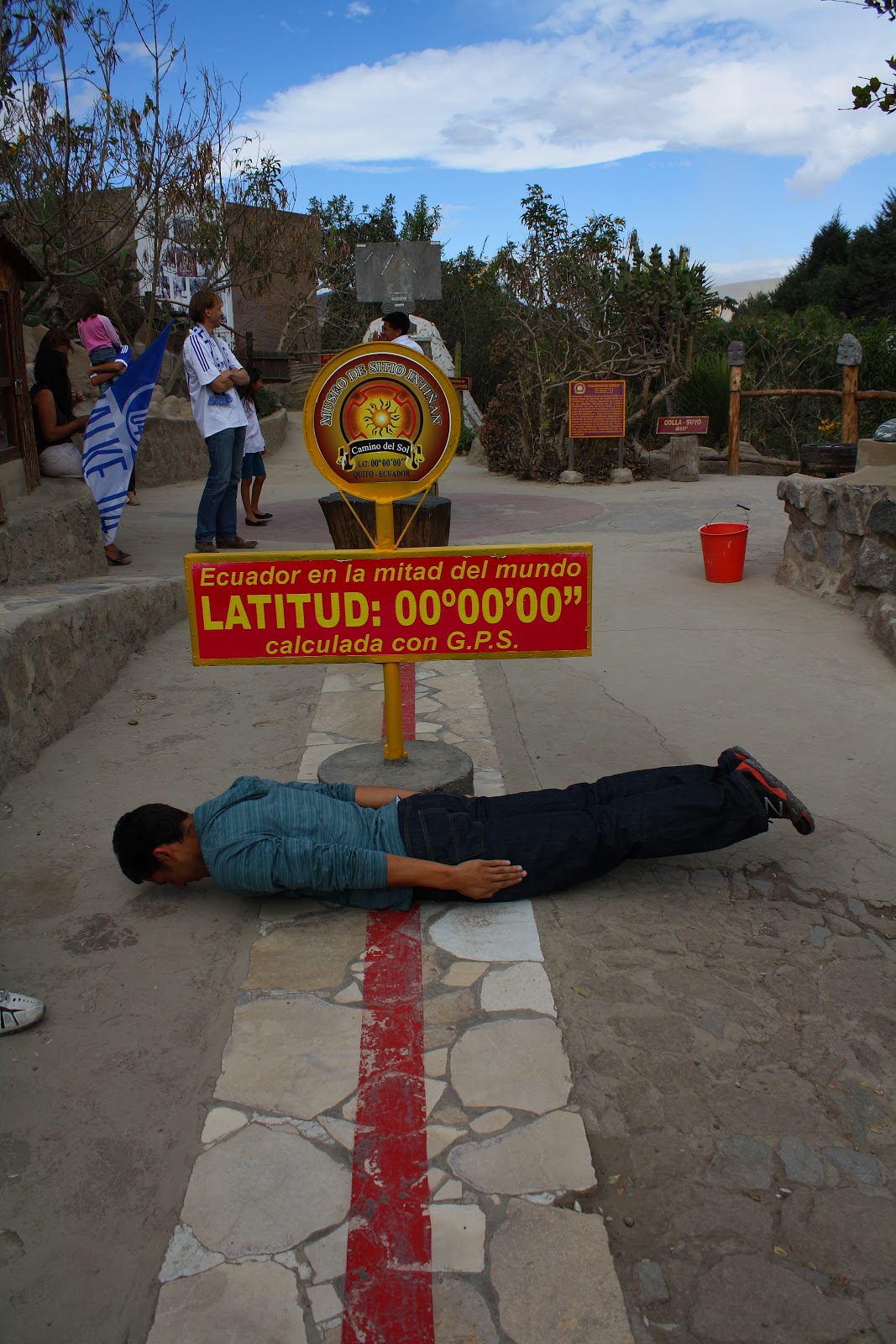
00°00′00″, the equatorial line. As your most excellent powers of observation might suggest , Ecuador is clearly not the only country the equator passes through. 
It all goes back to the French Geodesic Missions of 1736-1739. In the 18th century, there was a lot of debate in the French Academy of Sciences as to whether the circumference of the earth was greater around the equator or around the poles. Louis XV, the King of France, sent two expeditions to find the answer once and for all: one was sent to Lapland (close to the north pole), and the other was sent to Ecuador, which at the time was known as 'The Viceroyalty of Peru". The leader of the Ecuadorian expedition, in his reports back to France, apparently grew le tired of writing "Viceroyalty of Peru", and started referring to the land as Ecuador. The name stuck, and when Ecuador won its independence from Spain in 1822, it officially became known as 'The Republic of Ecuador'.

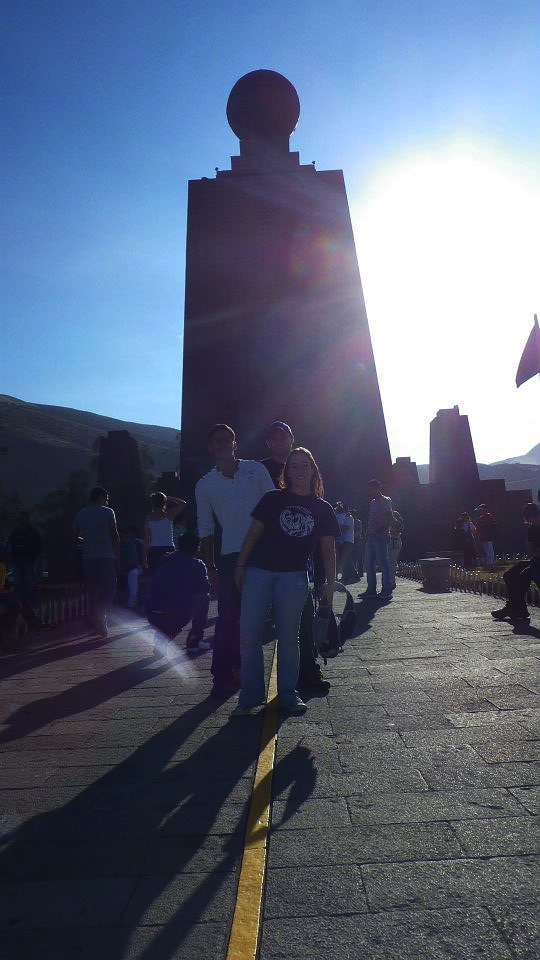
So that's how Ecuador got its name. And if you're ever in Ecuador, you HAVE to visit La Mitad del Mundo, the site where the French team performed their survey and obtained their measurements. Nowadays, you can find a huge monument there in commemoration of their expedition. How do you get there? Well, obviously, the site is located at the equator. Or is it? 

Actually, no. The French screwed up. They measured in the wrong place; their site is located 240m south of the actual equatorial line.
"MERDE, 240 METRES D'ERRUER. C'EST DE CONNERIES"  (also, this is what you get if you google 'angry french man')

What does this mean for us? Well, it means that there are now two different 'Mitad del Mundo' exhibits: one is Ciudad Mitad del Mundo, the government sponsored touristy site, where the monument honoring the french expedition is located (or as our group affectionally called it, the 'fake' Mitad del Mundo). The other is the "Museo Inti-Ñan", a site that claims to be located on the 'actual' equatorial line, as measured by GPS (we called it the 'real' Mitad del Mundo).

Over the span of two weekends, I visited both (coincidentally, there was a fight between Ecuadorian men on the bus on both trips, one of which involved an argument over a 25 cent bus fare and a bad-ass Zinedine Zidane headbutt).

The 'Fake' Mitad del Mundo. (Photo cred to random nice lady and Anna's camera)

The 'Real' Mitad del Mundo

Museo Inti-Ñan is by far the better deal. We got a cool tour guide that took us around different exhibits and related the history of the indigenous peoples of Ecuador.

"This is a penis" -Tour Guide

Cuí (AKA, Guinea Pigs). They are native to South America, and are a delicacy.

They also brought out a a traditional dancer in Curiquinge costume (Curiquinge is an Andean bird of prey, but it's also a dance), and a few of us got pulled in to dance.

Dance party. No one in the Andes got swagga like us.


And of course, we got to straddle the equatorial line (one of the few times in my life where I can say I was in two hemispheres at once). They also performed various 'scientific' experiments  showing the effects of being on the equator (more like parlor tricks, but they were kind of cutesy).

No trip is complete without a group picture. 


It's apparently harder to balance yourself on the Equator, but I think I just had too much Canelazo. 


Yup. Definitely too much Canelazo (Yes, I realize it's no longer 2010 and planking is out. But #HatazGonHate)