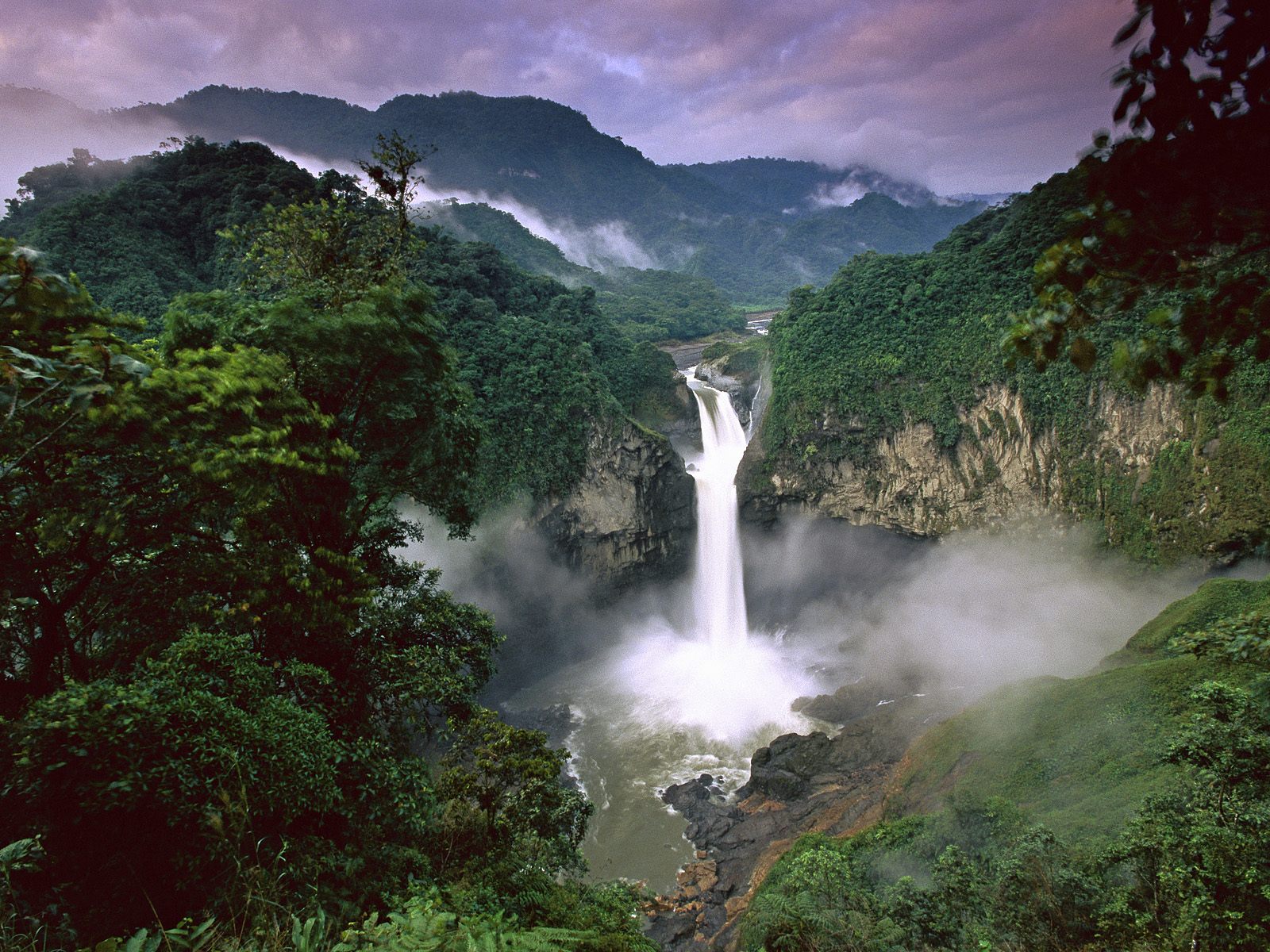
Why is rainforest biodiversity so special, and why do so
many plants and animals call it their home?
In the last two years, I’ve had the privilege of visiting
two of the great tropical rainforests of the world: the Ecuadorian Amazon, and
the Bornean rainforest. I consider it a privilege, because the majority of
people in the world never set foot inside of a rainforest. 50% of the world
population live in cities, and that number is projected to jump to 70% during
the next 35 years. The tropical rainforest is just about the last place the
average human would want to venture into, and it’s not that hard to see why. It’s
almost impossible to live in it.
.JPG) |
| Somewhere hidden between all those leaves and branches are countless species of insects, and other animals, invisible to our eyes. |
When western explorers first ran into the rainforests of the
Amazon, Africa, and Southeast Asia, and saw the immensely dense growth and all of
the gigantic trees, they concluded that the soils there must be the most
fertile on earth. Counter to intuition however, the soils there are some of the
most nutrient poor on earth. This is because nutrient cycling is incredibly
fast in the rainforest, and any nutrients that make it into the soil are
immediately absorbed by the roots of all the plants and taken up into the
canopy. In fact, 99% of the nutrients of the rainforest is found in the
vegetation itself, and not the soils. So any crops one tries to plant in the
rainforest will surely fail.
 |
| Other than the puny human (try to spot the climber up there!), within those trees are a whole lot of nutrients. |
If that wasn't enough of a deterrent to any would-be
residents of the rainforest, the rainforest is also an incredibly dense and
arguably one of the most difficult to navigate environments in the world. There
are few landmarks, and the trees are so high and the vegetation so dense that
one can’t see more than 50m into the distance. It’s no coincidence that the
word “jungle,” which is of sanskrit origin, means wasteland. Without sufficient training, equipment, and
supplies, a trip alone into the rainforest would end in disaster for the
average person. Our primate ancestors called the rainforest their home, but
ever since humans evolved their way into the savannas of Africa, few have
ventured back into their ancestral home. We just can’t live in it.
Funnily enough though, in the grand scheme of things, humans
seem to be the great outlier in terms of where we live. Covering less than 2% of
the earth’s surface, the rainforest nevertheless contains more than 50% of the
world’s species of plants and animals. More and more are discovered every day.
And not just small things like insects (like the plant
hopper!) or plants (like this crazy
Chilean chameleon vine – technically not in the rainforest but too cool to
not share). Mammals have been discovered as well, as shown by the recent
discoveries of the Olinguito
in the Amazon, and the venomous Slow
Loris in Borneo (the only known venomous primate in the world!).
Considering all of the life that’s out there, it’s crazy to think that many scientists
estimate that only one fifth of the world’s species have been described. Even
how the rainforest became so biodiverse is kind of a mystery, and there’s a
multitude of theories proposed to explain it. One of the reasons given is that
the environment is so heterogeneous and complex (to begin with, there is a
vertical element not seen in other environments to the extent as it’s seen in
the rainforest, which has trees 200+ft) that there are thousands of potential
niches for different animals to occupy, and speciate.
 |
| The golden-mantled tree kangaroo, recently discovered in the Foja mountains of Indonesia. I didn't even know there were kangaroos on this side of Wallace's line! |
So with all of this
biodiversity in the rainforest, you might think that if you walk into the
rainforest, you’ll be running into all sorts of animals left and right. The
truth is not quite that however. With all those impressive biodiversity facts
and species numbers I always heard about, the first time I visited the Amazon
rainforest in the fall of 2012, I was expecting to run into all sorts of crazy
animals the minute I walked out. So you can imagine my surprise when I found
the rainforest to appear overwhelmingly uniform. And to the untrained eye, that’s
exactly what it looks like: one big pile of green. Broccoli broccoli broccoli, everywhere.
Out in the open, there are no animals in sight or anything besides bunches of of
branches, vines, and leaves. You might spend a few days in the rainforest, and
then leave thinking “alright, I think I saw all there is to see.” But in actuality,
that couldn't be farther from the truth.
To get the most out of the rainforest, and experience the
biodiversity that it has to offer, it takes a lot of patience, and a very
observant eye. You know for a fact that everything is out there because your
ears don’t lie. You can hear the call of the wild every morning and every
night, when multitudes of species in the rainforest – cicadas, gibbons, birds,
etc. – call out and resonate throughout the rainforest. But everything,
absolutely everything is hiding. Under leaves, blending into the cracks of tree
trunks, high up in the canopy, almost every form of life out there blends into
its surroundings, and appears invisible to those who don’t know where to look. But
it The longer you spend in the rainforest, the better you’ll be at spotting
everything. It’s not ‘til then that you realize you could spend every hour of
every day walking around in the rainforest, and not see everything. Even the
big things! I have spent almost a year now living at Gunung Palung National
Park in Borneo, and I’ve yet to see any sun bears, leopards, pythons, or lemurs.
But they are out there, and I’m still holding out hope that I’ll at least get
to see a bear before I leave!
 |
| If I act like a sun-bear, maybe all the sun-bears will come out too. |
It takes a bit of luck to see cool things out here, some of
which I’ve had during my time at Gunung Palung. I’ve definitely seen over 15
orangutan matings now (so many that I’ve lost count!), which tend to be pretty
rare events to see, much less capture on film (which I also have!). I’ve also
seen two male orangutans go at it head to head on the ground, extremely rare
events to witness. My most notable sighting, and the source of a bit of
jealousy at camp, was when a Binturong (AKA, a bearcat!) ran up to me as I was
sitting somewhere up in the mountain; I heard a noise coming down hill, and
prepped my camera, unknowing of what exactly was coming down but ready to get
it on film. I got really excited when I saw what it was, but it passed by me so
quickly that I could only capture a moving blur on the camera. But the ‘cat’ in
the bearcat was a curious creature indeed, and when it spotted me it turned
around for a closer look. As it stared at me from a few meters away, I managed
to snap this photo, proof of my sighting to everyone at camp!
 |
| A Binturong, AKA a Bearcat. I bet there are only a handful of non-camera trap photos in the world taken of these guys in the wild. |
Every time you step into the rainforest, what you see is luck
of the draw, a spin of the wheel. But with some patience and a good eye, you
can double the odds. The rainforest can definitely be a bit overwhelming, but it
is without a doubt an awesome place to explore.